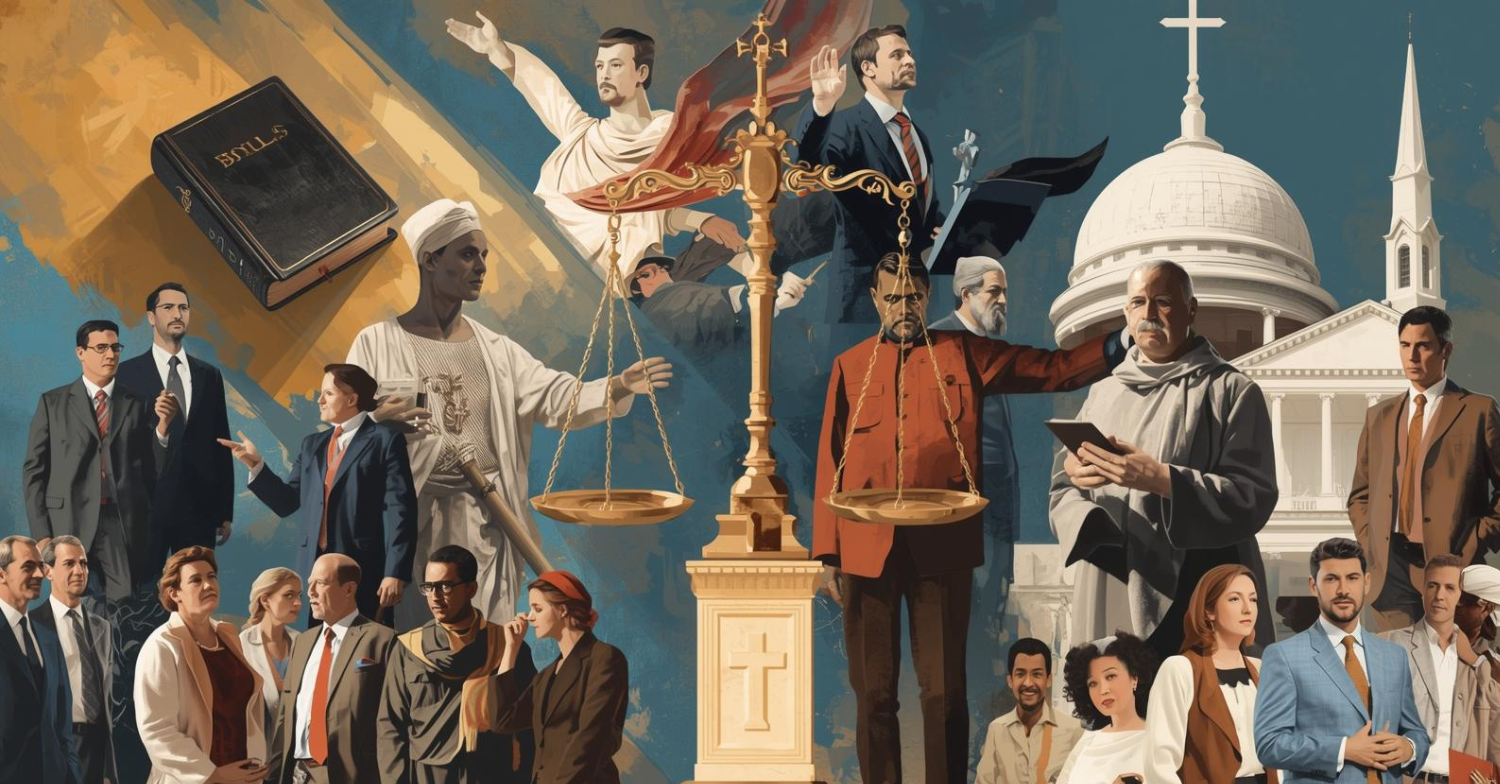
The question is never, “Law or no law; But who’s Law?” Is the Creator, Lawgiver, Judge, and King of the Cosmos the Author of the most perfect Law standard known to mankind, or is man, who is fallen, fallible and unpredictable, the perfect Lawgiver?
Perhaps another question that might be raised is “Does fallen, fallible, unpredictable man have the natural capabilities to discern from nature what is right and wrong, good and evil, permissible or forbidden?” Is a created being wiser than the Creator that made it? Since mankind is hopelessly subjective as a result of his fallen nature to perfectly determine a legal course of action for every situation by observing the Laws of nature, he is whole incapable of arriving at a perfect Law application. Therefore, there cannot be any reliable natural observable standard where just Laws be codified, let alone teach how to restore Law and order? One must then ask the question “Can any form of natural interpretation of the world that God made by mankind be entirely reliable when those same interpreting individuals are themselves products of a fallen world? This was the error of the Greeks who invented the Laws of Nature and Of Nature’s God (LONANG), which ultimately found its way into the Enlightenment, Deistic and Unitarian thinkers of the 18th century colonial period of America.
Never did any colonial proponents of the Law standard of LONANG, refer to God as the Trinitarian God Yahweh of Scripture, but rather as the World’s Great Architect and Supreme Master. Citing Shelton S. Wolin’s work on “Politics and Vision; the Continuity and Innovation in western Thought,” Gary North explains in his book, Political Polytheism,
‘For about 18 centuries, the foundation of the West’s ideological synthesis was men’s naïve faith in the existence of natural rights and natural law principles, discoverable by unaided human reason, or at least by [what was called] “right reason”. This intellectual construct was the invention of later Hellenistic philosophers who were trapped by the collapse of the Greek polis and its religious and philosophical underpinnings. They saw that the collapse of the polis and the simultaneous rise of empire made necessary a new philosophical outlook. Natural rights theory was their suggested solution.
The idea that the Laws of Nature and Of Nature’s God can establish a proper Law order that is not organically a pluralistic, (even perhaps an idolatrous) construct, will not only be able to stand the critique of Scripture, but it cannot even stand up against the scrutiny of history. These are just some of the issues that must be addressed, and then hopefully answered correctly, for any system of Law to be fully just and equitable. The organizing apparatus of any nation is then narrowed down to this: God’s Law (Theonomy) or man’s law (Autonomy).
Theonomy asserts that the only righteous framework for justice are the judicial Laws of the Old Testament, including the penology and restitution principles therein contained. Theonomy’s law system seeks to restore order to man and his societal structure by using God’s Divine Universal principles of Justice and Equity as detailed in God’s Covenant Law.
While incorporating New Testament legal principles to the Theonomic framework, (unless the New Testament specifically rescinds an Old Testament civil law such as the dietary or ceremonial laws) those laws retain their validity. Since all Law is the codification of ethics, Theonomy asserts that all Law must be based on the Laws of Scripture, which are Holy, Just and Good; i.e. the essence of God’s Ethical Law Code. Whenever there is a departure from, perversion or replacement of God’s Law standard, the result is judicial chaos and ultimately national destruction. This was God’s warning to Israel. Instead of adopting God’s Law they adopted the laws of the Egyptians, the Canaanites and the Persians, who looked to nature to decide their rule of Law and justice. By the time of the New Testament, the legal pollution by the Babylonian Talmud, Zoroastrianism and Greek philosophy was adopted into Israel’s Law code, ultimately finding its way into the Christian churches and later into the Enlightenment ideology of LONANG. Note God’s warning.
“Woe to them that go down to Egypt for help; and stay on horses, and trust in chariots, because they are many; and in horsemen, because they are very strong; but they look not unto the Holy One of Israel, neither seek the LORD! Yet he also is wise, and will bring evil, and will not call back his words: but will arise against the house of the evildoers, and against the help of them that work iniquity. Now the Egyptians are men, and not God; and their horses flesh, and not spirit. When the LORD shall stretch out his hand, both he that helpeth shall fall, and he that is holpen shall fall down, and they all shall fail together.” Isaiah 31:1-3
While the proponents of the LONANG seek to be separated from Natural Law theorists, there are too many similarities to ignore since both groups use “natural human reasoning” to construct concrete Law systems. As already stated, one of the arguments against LONANG is that of its “subjectivity”. Any human observation of nature’s evidence to construct a reliable system of Law and order is always libel for personal interpretation. While LONANG proponents believe that Law can be found in God’s created order, they forget that even the created order exists in a corrupt form. How then can a clean thing (i.e. A perfect Law Code) come forth from an unclean thing (i.e. a Law code from man’s interpretation from a fallen world)? Furthermore, there can be no predictable or reliable penal code derived from LONANG apart from God’s written Biblical penology. Since a proper penal code exists to restore the victim, his rights, and the Universal order of God’s world, a reliable, God-centered, restorative penology is imperative. Instead of relying on the ‘light of nature’ and human reason to codify laws, Theonomists believe that a reliance on specific Biblical mandates is the only vehicle for a complete reliable system of Law which is both pleasing to God and one which ensures the security of a nations well-being. Commenting on the ethical continuity of the Law of Moses as the basis for the modern application of the Biblical Legal sanctions, John Calvin writes,
“Wherefore let us mark well, that to discern that there is nothing but vanity in all worldly devices, we must know the Laws and Ordinances of God. But if we rest upon men’s laws, surely it is not possible for us to judge rightly. Then we need to first go to God’s school, and that will show us that when we have once profited under him, it will be enough. That is all our perfection. And on the other side, we may despise all that is ever invented by man, seeing there is nothing but foolishness, weakness, want of sense of judgment, and uncertainty in them. And that is the cause why Moses terms them rightful ordinances. As if he should say, it is true indeed that other people have a store of laws, but there is no right at all in them, all is awry, all is crooked…[T]here exists a plain and complete guideline for [us] in the Law of Moses, to which we need to simply cling if we want to follow the right path. Therefore, whoever adds or takes away anything from it exceeds the limit.” (John Calvin Sermons on Deuteronomy p122, & Treatises Against the Anabaptists and against the Libertines pg78)
Any argument that posits that the Law of God was specifically structured and then given as a Law code only to the ancient nation of Israel but was never intended to structure the nations of the world will have to contend with Deuteronomy 4:5-8, Matthew 5:17-18 and Matthew 28:19-20. These verses should put to rest any notion that the Law of God is anything but a Universal Law code for the nations of the world to follow. By God’s inspiration Isaiah warns:
“To the law and to the testimony: if they speak not according to this word, it is because there is no light in them.” Isaiah 8:20.
One criticism of Theonomy is its harshness. But is that a valid criticism as if to say that God’s perfect Law is not holy, just and righteous but tyrannical? This argument is born out of the heresy of Gnostic dualism, which posits that the God of the Old Testament is the mean God, and the God of the New is the loving God; the kind God; the forgiving God; the meek and lowly God and not the God of Justice and Vengeance against His enemies. Yet, the Scripture is crystal clear that Jesus is the same today, yesterday and forever. Since God’s Law does not always demand the maximum penalty for all crimes, as it was in ancient Israel, the maximum penalty for certain crimes is not always mandatory. For example: In the case of adultery, while the maximum penalty was death, in order to show the destructive nature of the crime against the family, there was the possibility of a lesser sentence if the victim specified a restorative sentence other than execution. A return to the principles of God’s Law, its standards, and penal sanctions, is the only way to ensure God’s blessing, bringing peace and prosperity to our nation. To reject God’s Law is to reject the Lawgiver.
Contact:
Rev Dr Paul Michael Raymond
pastor@hisglory.us
1 Comment
Comments for this post are now off.
GAYuMilVdcAJvRnuitSgqBFs