Today's Student Data is Tomorrow's Reputation
THE DATA PROFILE – Your Child’s First Social Credit Score

Rhonda Thomas Today's Student Data is Tomorrow's ReputationTHE DATA PROFILE – Your Child’s First Social Credit Score
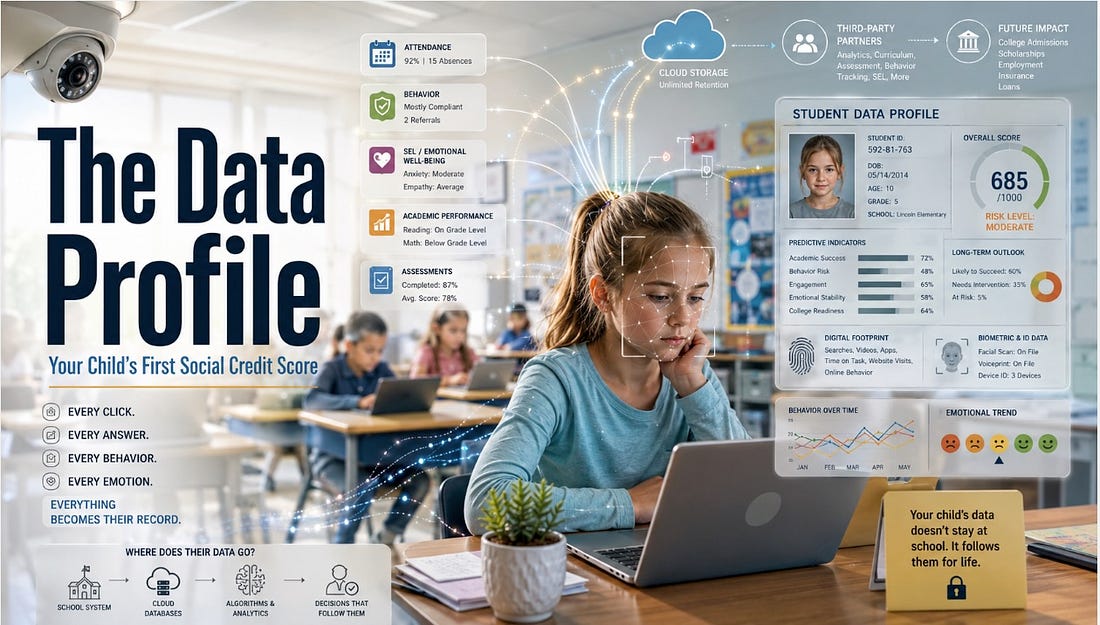
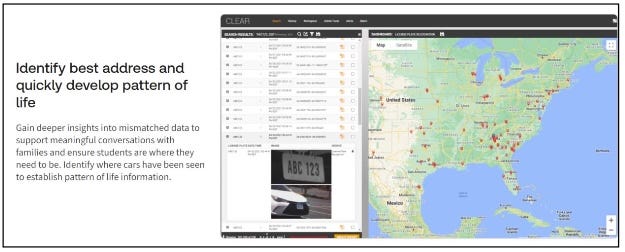
THE DATA PROFILE – Your Child’s First Social Credit ScoreThe data collection framework in schools is preparing students to become the pioneer generation of a social credit score system – without them ever realizing it. The Data Collection Framework of Public EducationUnder the guise of student safety, surveillance programs collect a wide range of data to include AI-driven behavioral detection, social media monitoring, student communications monitoring, online and web monitoring, and remote video monitoring/proctoring. These programs are software installed on student devices and attached to student school logins, using a search algorithm to constantly scan all student activities to identify material that is problematic and subsequently alert designated school or law enforcement personnel. Activities monitored can include social media posts, chats, documents, comments, emails, and more. While seemingly limited to school devices, this surveillance software can also function on a student’s private devices at home if a student uses their school-issued login for a program or social media account. Types of collected data can include student and parent/guardian first and last names, physical address and email address, along with parent/guardian phone numbers, student ID, and a student’s location during use. In perhaps the most alarming example of modern student surveillance, the CLEAR software product by Thomson Reuters allows designated school district personnel to “[a]ccess license plate data and develop pattern of life information” on students and families:
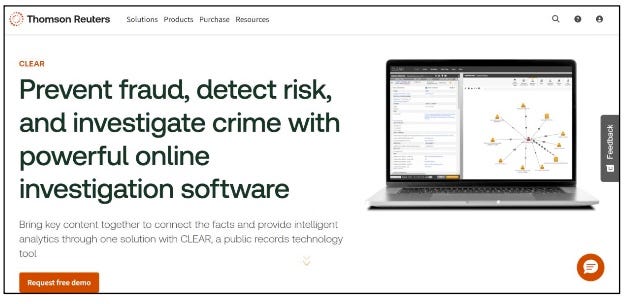
2026© 1Image from Thomson Reuters CLEAR While marketing itself as a solution to help school personnel save time verifying student addresses, the software capabilities go far beyond address and residency verification, with features such as alert functions to allow district personnel to “[g]et notified immediately when any relevant information changes with a student.” These expansive surveillance functions are not surprising, given that the company’s own description as a “powerful online investigation software” with applications in law enforcement and investigative financial services, among others.
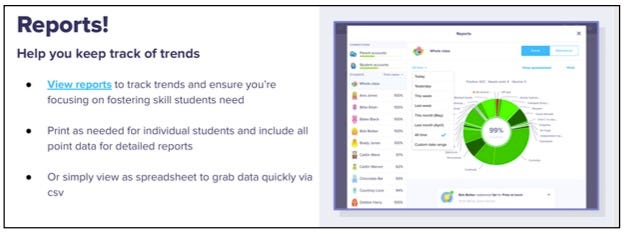
Image from Thomson Reuters CLEAR By enrolling their child in the public education system, parents must understand that they are allowing their child and family to be subject to extensive surveillance, while also helping to create their child’s permanent data profile with the information collected. Behavior Profiling of Students through Data CollectionOther types of surveillance data focus on logging a child’s daily social choices. Programs like ClassDojo document behaviors such as showing respect, curiosity, washing hands, being off task, giving air hugs, and much more. Points are given to reward behavior deemed positive or removed to punish behavior deemed negative. Queries can be conducted to display a child’s social choice metrics over selected time frames, and scores can even be ranked among class members to determine which students perform the best and which ones perform the worst. The data is generally integrated into the child’s K-12 education record where it remains indefinitely, often without parental knowledge or consent. Even more concerning is that parents are not guaranteed access to their child’s behavior reports. The company states that school district administrators can customize parent reports by deciding “whether to share all points, only positive points, or no points at all with family members and students.”
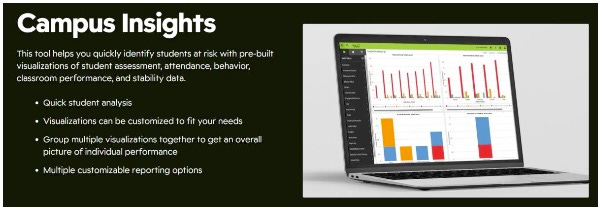
Image from ClassDojo The surveillance data collected on a child at school is ultimately combined with the child’s other data and integrated into a combined student profile using programs such as Infinite Campus, which not only track student measurements but use predictive analytics and “statistical algorithms [to] measure how factors such as attendance, behavior, academics, and home and school stability interact to predict graduation.” Infinite Campus also provides “daily risk predictions” and surveys measuring emotional states, contributing to each student’s assigned score in categories such as “[a]ttendance, behavior, curriculum, and stability.” By combining student data and feeding it continuously into analytical models, the program boasts its promise that “no one slips through the cracks.”
Image from Infinite Campus Student Data Profiling and Social Credit Score SystemsThe data gathering and student profile records of the public education system are eerily similar to the framework of the social credit score system used in China. This system is built upon a framework of citizen data gathered through video monitoring, location tracking, banking data, individual purchases, financial transactions, travel, online activity, social media interactions, and more, filtered through algorithms and assigned points to create a social credit “score” for each citizen.9 These scores are increased when positive behavior actions are logged and decreased in accordance with negative actions. Positive actions can include good works such as donating blood or volunteering while negative actions can include exercising one’s right to petition the government or defying authority. Consequences accompany one’s social credit score, with perks for those with high scores and difficulties for those with low scores to include inability to access financing or even being prohibited to travel. Like the behavioral tracking and investigative programs of public education, China’s social credit score system relies upon data gathered from a wide array of physical and digital surveillance tools, using powerful AI-driven analytics to create and monitor profiles on each tracked individual. And like with ClassDojo, social behaviors are categorized and logged, with administrators determining who has access to the records. Positive and negative behaviors are arbitrary, determined solely based upon what governmental authorities determine to be desirable behaviors in society. Whether these governmental authorities are school district personnel or Chinese Communist Party leaders, the system – and its purpose of training the minds of citizens– remains the same. ConclusionPerhaps the most concerning of all is the fact that students – and parents – rarely seem to question the data being collected and stored about them. Rather than voicing concerns about privacy, students see surveillance as a necessary fact of life to exist in a safe society. Some would even frown upon those who question it, as questioning implies that someone “has something to hide,” creating the false conclusion that only those with bad intentions desire privacy from government surveillance and profiling. This widespread acceptance creates the ideal ground for not only a social credit score system but also for an entire digital city infrastructure built upon centralized surveillance and control – all without citizen knowledge or public discourse. From a Biblical Christian perspective, social credit score systems in public education are even more problematic. Such systems teach obedience to government-dictated morals, thus placing the State as the determiner of right and wrong rather than God. Children in school learn to follow written rules rather than understand the wisdom of God’s natural law of morality written on the hearts of men. They are taught to expect rewards for their obedience and don’t understand that choosing true morality can result in discomfort or hardship, especially when it challenges what the state and even society has deemed to be correct. The system reinforces to children that they should be moral because they are being watched and documented rather than being moral because they know and love God. Replacing a biblical foundation of morals with a state-centered one should be of paramount concern for all Christian parents whose children are being educated in the public school system. Truth In Educationinfo@truthineducation.org©2026 All rights reserved. Short quotations may be used with proper attribution. This article may be shared in full, unaltered, with clear attribution to Truth In Education. The full article, along with supporting sources, is available on our website. |