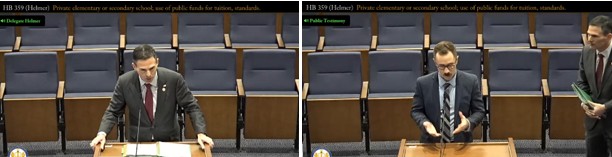
Delegate Helmer and the Virginia Education Association (VEA), which helped draft HB 359, repeatedly asserted that the bill is narrowly focused on schools participating in the federal scholarship tax credit program if Virginia remains a participating state. That claim is demonstrably false.
Both the introduced bill and the committee substitute define “public funds” broadly to include tuition assistance derived from state and federal vouchers, education savings accounts, tax credits and deductions, or “other arrangements.” This language is intentionally expansive and would apply far beyond any single federal program, sweeping in future state and federal tuition assistance initiatives that do not yet exist.
The House Education Committee approved a substitute that includes a narrow carve-out for the existing Education Improvement Scholarships Tax Credit (EISTC) program. While that change is welcome, it does not fix the bill’s fundamental flaws. The bill remains deeply problematic and now advances to a House Appropriations subcommittee on elementary and secondary education due to its fiscal impact, but it could also be heard in the full committee this week.
HB 359 represents a direct assault on private education, rivaling regulatory efforts seen in states like California. It establishes a dangerous framework that subjects private schools to sweeping state control if they enroll even one student receiving tuition assistance, whether through a federal program, any future state program, or any other public subsidy.
This threat is not hypothetical. If new federal or state tuition assistance programs are created, HB 359 ensures that private schools would immediately be subjected to public-school mandates as a condition of participation. The predictable result is that many private schools will opt out entirely.
As a result, only wealthy families will be able to afford private education, while low-income and working-class families, the very families educational choice is meant to serve, will be shut out. So much for affordability!
In practice, HB 359 forces private schools into an impossible choice: abandon their mission, independence, and religious identity, or stop serving families who rely on educational assistance.